Accueil » News » News » Ethereum solves blockchain trilemma with PeerDAS and ZK-EVMs
Ethereum solves blockchain trilemma with PeerDAS and ZK-EVMs
After a 10-year journey, Ethereum has solved the blockchain trilemma. PeerDAS enables data availability sampling whilst ZK-EVMs verify blocks efficiently.
Vitalik Buterin, Ethereum’s creator, announced on 5th January 2026 that Ethereum solved its biggest technical challenge. For years, blockchains had to choose between three important features they could never have together. They could be decentralised, meaning thousands of regular people can participate rather than just big companies. They could have consensus, meaning everyone agrees on what transactions actually happened without trusting a central authority. Or they could have high speed, meaning they can process lots of transactions quickly and cheaply.
Until now, blockchains could only pick two of these three features at once. BitTorrent from 2000 was fast and decentralised but had no way for everyone to agree on truth. Bitcoin from 2009 was decentralised with consensus but very slow because every computer downloads and checks identical information. Ethereum now achieves all three features using two technologies working together called PeerDAS and ZK-EVMs. PeerDAS is already running on Ethereum’s main network today, whilst ZK-EVMs are ready for real-world use. This means Ethereum can process far more transactions whilst anyone with a normal computer can still verify everything.
What Is The Blockchain Trilemma? A Race For All Blockchains - Transak
How checking random samples replaces downloading everything
PeerDAS solves a problem called data availability, which sounds complex but is actually quite simple. When someone creates a new block of transactions, they must share all the data with the network. But what if someone creates a block and then hides some of the data inside it? Nobody else can check if the block is valid because the information needed is missing. PeerDAS uses a mathematical trick called erasure coding, similar to how DVDs can still play with scratches. The block data gets expanded so that any half of the expanded version can rebuild the original. Think of it like taking 100 puzzle pieces and creating 200 pieces where any 100 can complete the picture.
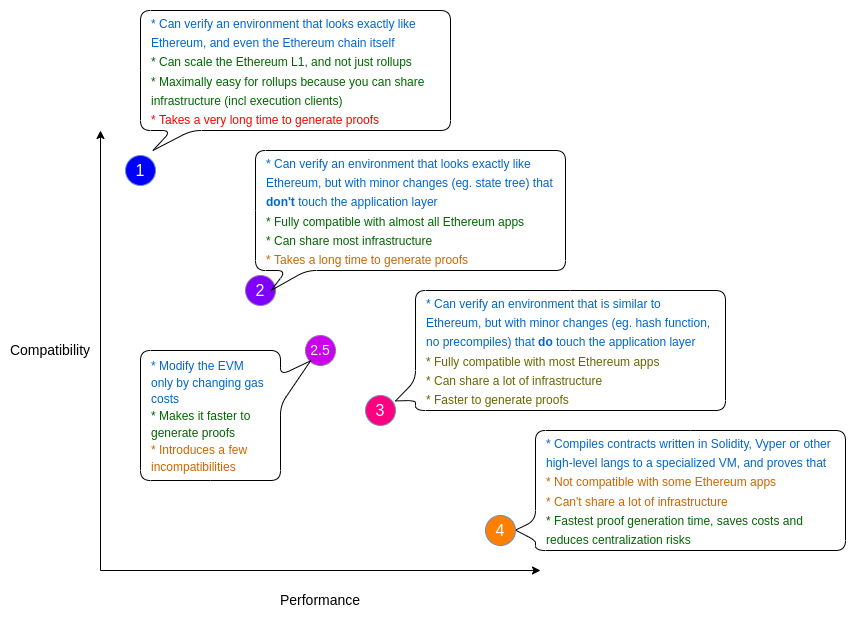
Users randomly check 20 or 30 pieces from different parts to see if they can download them. If all random checks work, they know with near certainty that the full block is available. This is like checking random pages in a book to confirm the whole book exists in the library. ZK-EVMs are the second technology, which proves blocks are correct without everyone re-checking every transaction manually. Instead of 10,000 people all doing the same maths homework, one person does it and provides a certificate proving their work. Everyone else can verify the certificate instantly rather than redoing hours of calculations themselves.
zkEVM types comparison by Vitalik
Ethereum's roadmap brings this vision to reality through 2030
Buterin outlined how these technologies will deploy across Ethereum over the next four years. In 2026, blocks will be able to hold more transactions because the network can handle larger amounts of data. Think of this like widening a motorway from two lanes to four lanes for more traffic. People will also be able to run special nodes that use ZK-EVM technology to verify blocks faster. Between 2026 and 2028, Ethereum will adjust how it prices transaction space and reorganises how it stores information. These changes make sure that even with much larger blocks, regular computers can still participate in the network. Between 2027 and 2030, blocks will grow even larger as ZK-EVMs become the main way people verify transactions.
Eventually, Ethereum wants no single person or company to ever hold a complete block in one place. Instead, different people will build different pieces that get assembled automatically by the network itself. This prevents any single entity from controlling which transactions get included or blocked unfairly. Buterin emphasised this is not experimental theory but actual working technology running on Ethereum right now. This 10-year journey transforms Ethereum from everyone doing identical work to everyone doing different specialised pieces together.
En tant qu'entrepreneur et crypto investisseur, je me tourne complexe de la finance et de la blockchain sujets en clair, attractif et accessible, même pour les débutants. Mon but est d'aider chacun à mieux comprendre les principaux défis qui façonnent aujourd'hui et de demain crypto paysage.
Rejoignez-nous
Plongez dans le BIM Blog, votre guide de go pour blockchain, cryptocurrencies, et un utile glossaire pour approfondir votre compréhension. Ici, nous briser les derniers sujets d'actualité tout en fournissant des indications claires pour vous aider à naviguer et à grandir en toute confiance dans des champs.
Lien partenaire avis: Cette page présente les différents actifs, produits et services liés à l'investissement. Certains de ces liens sont des liens partenaires, ce qui signifie que si vous effectuez un achat ou inscrivez-vous à travers eux, nous pouvons recevoir une commission de notre partenaire. Cela aide à soutenir le BIM de l'écosystème et de notre mission de vous fournir des, contenus de haute qualité. Rassurez-vous, cela ne vous affecte pas, en aucune façon, et vous pouvez même bénéficier de certains avantages par le biais de nos liens.
Des rendements élevés ne garantissent pas toujours les bénéfices. Tout placement à haut rendement est livré avec un haut niveau de risque. Assurez-vous que le niveau de risque que vous prenez est aligné avec vos objectifs, votre horizon de placement et votre tolérance à l'égard de la perte.
L'investissement attention: Investir dans les cryptocurrencies comporte des risques. Alors que nous nous efforçons de mettre en avant la qualité des produits et des services, nous ne pouvons pas être tenu pour responsable des conséquences de vos décisions d'investissement. Crypto-actifs sont volatils par nature: faire vos propres recherches, d'évaluer vos risques, et n'investissez que ce que vous pouvez vous permettre de perdre. Les informations fournies ici ne constituent pas des conseils financiers.
Ne misez pas votre capital si vous n'êtes pas préparés à faire face à des pertes potentielles.