Accueil » News » News » Ethereum solves blockchain trilemma with PeerDAS and ZK-EVMs
Ethereum solves blockchain trilemma with PeerDAS and ZK-EVMs
After a 10-year journey, Ethereum has solved the blockchain trilemma. PeerDAS enables data availability sampling whilst ZK-EVMs verify blocks efficiently.
Vitalik Buterin, Ethereum’s creator, announced on 5th January 2026 that Ethereum solved its biggest technical challenge. For years, blockchains had to choose between three important features they could never have together. They could be decentralised, meaning thousands of regular people can participate rather than just big companies. They could have consensus, meaning everyone agrees on what transactions actually happened without trusting a central authority. Or they could have high speed, meaning they can process lots of transactions quickly and cheaply.
Until now, blockchains could only pick two of these three features at once. BitTorrent from 2000 was fast and decentralised but had no way for everyone to agree on truth. Bitcoin from 2009 was decentralised with consensus but very slow because every computer downloads and checks identical information. Ethereum now achieves all three features using two technologies working together called PeerDAS and ZK-EVMs. PeerDAS is already running on Ethereum’s main network today, whilst ZK-EVMs are ready for real-world use. This means Ethereum can process far more transactions whilst anyone with a normal computer can still verify everything.
What Is The Blockchain Trilemma? A Race For All Blockchains - Transak
How checking random samples replaces downloading everything
PeerDAS solves a problem called data availability, which sounds complex but is actually quite simple. When someone creates a new block of transactions, they must share all the data with the network. But what if someone creates a block and then hides some of the data inside it? Nobody else can check if the block is valid because the information needed is missing. PeerDAS uses a mathematical trick called erasure coding, similar to how DVDs can still play with scratches. The block data gets expanded so that any half of the expanded version can rebuild the original. Think of it like taking 100 puzzle pieces and creating 200 pieces where any 100 can complete the picture.
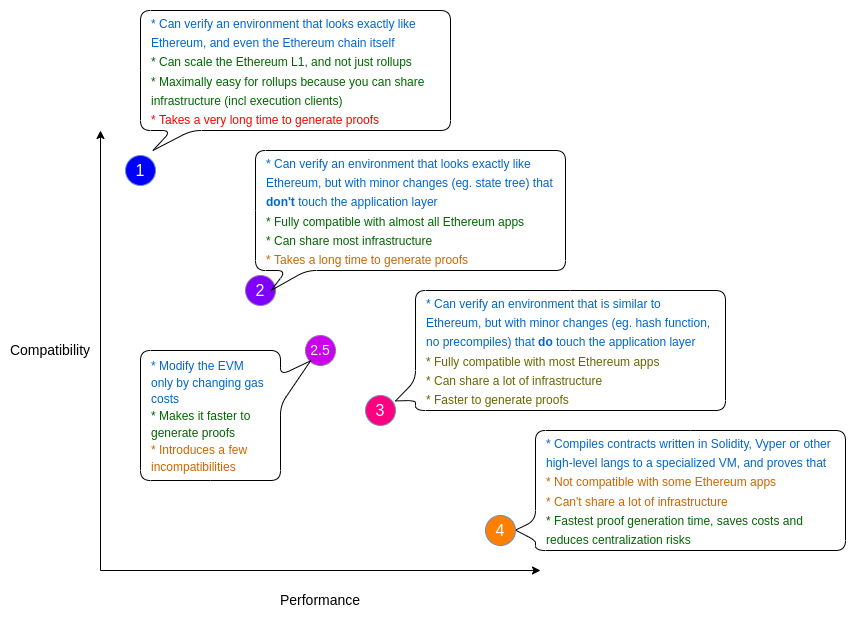
Users randomly check 20 or 30 pieces from different parts to see if they can download them. If all random checks work, they know with near certainty that the full block is available. This is like checking random pages in a book to confirm the whole book exists in the library. ZK-EVMs are the second technology, which proves blocks are correct without everyone re-checking every transaction manually. Instead of 10,000 people all doing the same maths homework, one person does it and provides a certificate proving their work. Everyone else can verify the certificate instantly rather than redoing hours of calculations themselves.
zkEVM types comparison by Vitalik
Ethereum's roadmap brings this vision to reality through 2030
Buterin outlined how these technologies will deploy across Ethereum over the next four years. In 2026, blocks will be able to hold more transactions because the network can handle larger amounts of data. Think of this like widening a motorway from two lanes to four lanes for more traffic. People will also be able to run special nodes that use ZK-EVM technology to verify blocks faster. Between 2026 and 2028, Ethereum will adjust how it prices transaction space and reorganises how it stores information. These changes make sure that even with much larger blocks, regular computers can still participate in the network. Between 2027 and 2030, blocks will grow even larger as ZK-EVMs become the main way people verify transactions.
Eventually, Ethereum wants no single person or company to ever hold a complete block in one place. Instead, different people will build different pieces that get assembled automatically by the network itself. This prevents any single entity from controlling which transactions get included or blocked unfairly. Buterin emphasised this is not experimental theory but actual working technology running on Ethereum right now. This 10-year journey transforms Ethereum from everyone doing identical work to everyone doing different specialised pieces together.
As an entrepreneur and crypto investor, I turn complex finance and blockchain topics into clear, engaging, and accessible content, even for beginners. My goal is to help everyone better understand the key challenges shaping today’s and tomorrow’s crypto landscape.
Join us
Dive into BIM Blog, your go-to guide for blockchain, cryptocurrencies, and a helpful glossary to deepen your understanding. Here, we break down the latest hot topics while providing clear insights to help you navigate and grow confidently within these exciting fields.
Partner link notice: This page features various assets, products, and services related to investing. Some of these links are partner links, meaning that if you make a purchase or sign up through them, we may receive a commission from our partner. This helps support the BIM ecosystem and our mission to provide you with relevant, high-quality content. Rest assured, this does not affect you in any way, and you may even benefit from certain advantages through our links.
High returns do not always guarantee profits. Any high-yield investment comes with an equally high level of risk. Make sure the level of risk you take aligns with your goals, your investment horizon, and your tolerance for loss.
Investment caution: Investing in cryptocurrencies involves risks. While we make every effort to highlight quality products and services, we cannot be held responsible for the consequences of your investment decisions. Crypto-assets are volatile by nature: do your own research, assess your risks, and only invest what you can afford to lose. The information provided here does not constitute financial advice.
Do not stake your capital if you are not prepared to face potential losses.