New way to enable trustless AI agent collaboration
The Ethereum Foundation launched the ERC-8004 standard. This new standard introduces a discovery mechanism and portable reputation system allowing AI agents to interact across different organisations without centralised intermediaries. AI agents are autonomous software programs that can perform tasks, make decisions, and interact with other systems independently. ERC-8004 addresses a critical challenge as these autonomous agents increasingly handle value, exchange data, and make independent decisions. Traditional trust models were built for humans rather than machines operating at scale across organisational boundaries. The standard uses blockchain as a neutral reference point while keeping most computation and interaction off-chain to maintain cost efficiency.
Over 10,000 agents had already been registered on testnets before the mainnet deployment, demonstrating developer interest in the protocol. Testnets are experimental blockchain networks where developers test new features before launching them on the main network. The team plans to extend deployment to all major Layer 2 networks in the coming weeks to enhance cross-platform reputation circulation. This launch marks the beginning of the 8004 Genesis Month according to announcements from the Ethereum Foundation AI team.
ERC-8004: Infrastructure for Autonomous AI Agents
Providing identity, reputation and validation
ERC-8004 relies on three fundamental pillars implemented as lightweight registries that live on the blockchain. The identity registry assigns each AI agent a unique identifier that works like a digital passport for autonomous software. This provides every agent with a portable identifier that can be transferred across different applications and platforms. The reputation registry stores signed client feedback creating a verifiable rating system for digital assistants that accumulates over time. Think of this like a permanent review history that follows an AI agent wherever it goes, similar to ratings on e-commerce platforms. These public reputation data become reusable by any application to evaluate an AI agent’s credibility before engaging with it. The validation registry allows agents to submit their work to independent verification with results stored on Ethereum permanently.
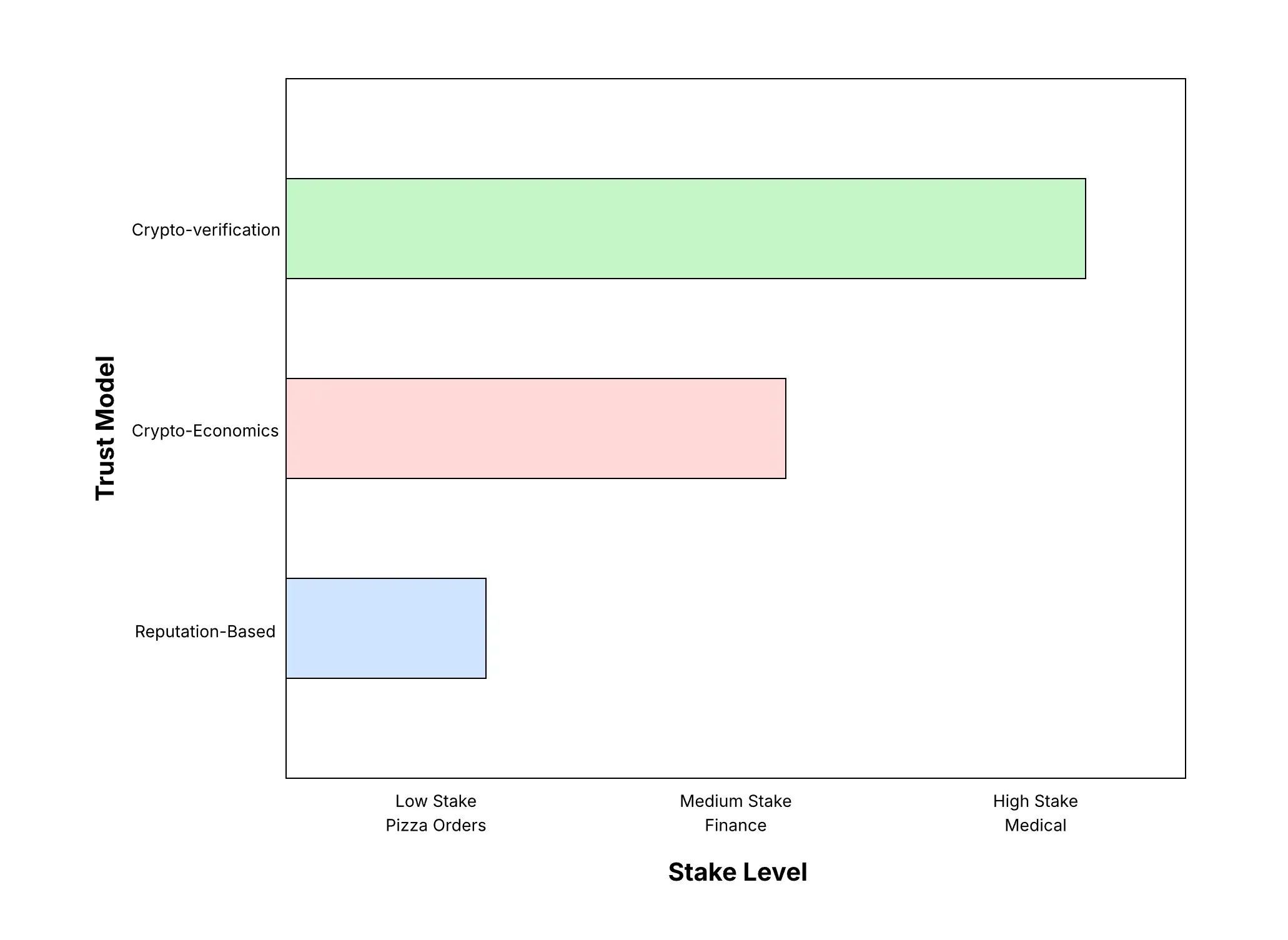
Validators are independent parties who check that AI agents completed tasks correctly according to specific criteria and standards. Trust models are tiered by security levels spanning low-risk tasks like ordering food to high-risk operations like medical diagnostics. The heavy data stays off-chain while references and integrity verification live on-chain for cost efficiency and scalability. This means most information is stored elsewhere while only critical proof data stays on the expensive blockchain. ERC-8004 does not handle execution, payments, or orchestration but serves as a trust primitive for the broader agent economy.
ERC-8004: Infrastructure for Autonomous AI Agents - QuillAudits
Positioning Ethereum as settlement layer for the machine economy
With ERC-8004, Ethereum extends beyond managing monetary transactions to address the crucial challenge of programmable trust for AI systems. By offering portable identity and transparent reputation to autonomous agents, the standard could transform Ethereum into the backbone of a fragmented AI ecosystem. Currently, most AI systems operate in closed environments controlled by large technology companies without interoperability (OpenAI, Anthropic,etc). This development positions Ethereum as a critical infrastructure in the AI wave by providing decentralised, tamper-proof settlement and collaboration tools. The integration creates new use cases for ETH including collateral for AI agents and payment fees, consolidating its position as a global settlement layer.
As AI agents drive increased on-chain activity, Ethereum’s economic model could benefit from higher transaction volumes and complexity. The standard complements payment protocols which handle compensation while ERC-8004 addresses identity and trust questions. The decentralised AI team at the Ethereum Foundation is led by core developer Davide Crapis with contributors including MetaMask AI Lead Marco De Rossi. The team’s mission is making Ethereum the preferred settlement and coordination layer for AI and the machine economy going forward. ERC-8004 unlocks a global interoperable market where AI services can interact without gatekeepers, enabling credibility to travel everywhere agents operate.
As an entrepreneur and crypto investor, I turn complex finance and blockchain topics into clear, engaging, and accessible content, even for beginners. My goal is to help everyone better understand the key challenges shaping today’s and tomorrow’s crypto landscape.
Join us
Dive into BIM Blog, your go-to guide for blockchain, cryptocurrencies, and a helpful glossary to deepen your understanding. Here, we break down the latest hot topics while providing clear insights to help you navigate and grow confidently within these exciting fields.
Partner link notice: This page features various assets, products, and services related to investing. Some of these links are partner links, meaning that if you make a purchase or sign up through them, we may receive a commission from our partner. This helps support the BIM ecosystem and our mission to provide you with relevant, high-quality content. Rest assured, this does not affect you in any way, and you may even benefit from certain advantages through our links.
High returns do not always guarantee profits. Any high-yield investment comes with an equally high level of risk. Make sure the level of risk you take aligns with your goals, your investment horizon, and your tolerance for loss.
Investment caution: Investing in cryptocurrencies involves risks. While we make every effort to highlight quality products and services, we cannot be held responsible for the consequences of your investment decisions. Crypto-assets are volatile by nature: do your own research, assess your risks, and only invest what you can afford to lose. The information provided here does not constitute financial advice.
Do not stake your capital if you are not prepared to face potential losses.